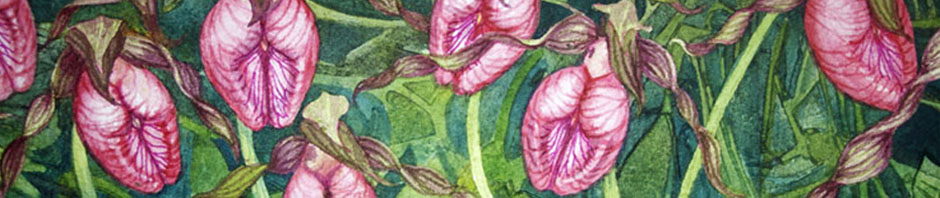
Visit the post for more.
Source: Alison Gates

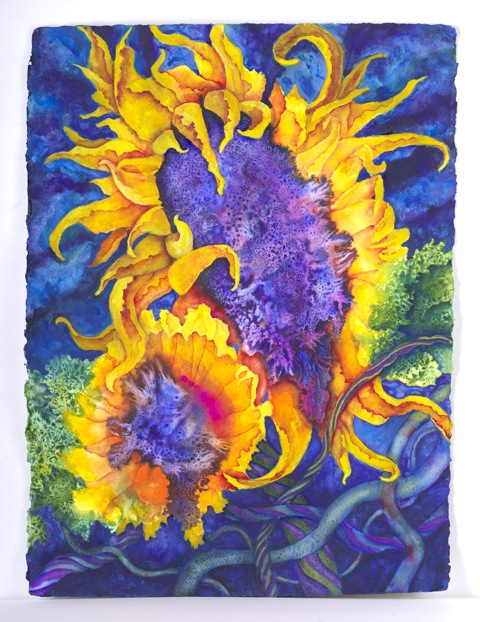
Study of Jamie’s Dahlia, 8×11, watercolor, ©2012 Helen Klebesadel
Please visit my new blog on my new website at http://klebesadel.com/blog/. My newest post discusses my experience teaching art workshops in Frank Lloyd Wright designed Wyoming Valley School Cultural Arts Center near Spring Green, Wisconsin. You can find me posting there from now on. Please join me there!
Helen R Klebesadel

Susan Grabel. Venus in Proliferation, sculpture, 2006.
From January through May this year Staten Island artist and activist Susan Grabel had a retrospective of her work entitled “Constructions of Conscience” at the Staten Island Museum. The exhibition spanned her 35 plus years of creating art with a social purpose, and brought together works representing feminist critiques of contemporary culture that have brought a larger meaning to her creative work throughout her career.
Susan Grabel explores the human dimension of social issues in sculptures of handmade cast paper, clay and mixed media and collagraph prints and collages. For many years Susan was best known as a sculptor of small humanistic clay figures and vignettes. Throughout her career Susan’s creative work has always had an intimacy and empathetic feeling for the common person.
Her works for the last decade have focused on her ‘Venus’ images of cast paper. In this series she examines the female image as it is, not idealized, not glamorized, but projected as a real and unvarnished display of female anatomy subject to the effects of aging, childbearing and gravity. These pieces are sculpted in clay and then cast in paper. They vary in size from figurines about six inches in height, to full figured woman slightly over life sized. In making the work she first forms the figures in clay and then casts it in paper, producing somewhat fragile yet elegant torsos with the strength of lives fully lived. In these works there are no heads or extremities but there form speaks volumes.
Her work often demonstrates how the prevalent female ideal (underweight, young and artificially smooth) bears no resemblance to real women by contrasting this idea of an ‘ideal’ with the bodies of large, round women whose age and experience shows on their bodies. None-the-less her fuller figured and sometimes deeply scarred “Venus” series represent the beauty of life lived fully as a woman.
The oldest work, Caught in the American Dream, from 1978, critiques our overwhelming in consumer culture, and exemplifies Susan’s long term commitment to social commentary through her art.

Susan Grabel, Caught in the American Dream, ceramic 1978
Her works in the 1990s examined homelessness by representing individuals, sometimes children, as beautifully modeled portraits in dry, unglazed clay often presented in rough boxes, made of slats.

Susan Grabel, Dirge, Mixed Media
Susan says of her creative and activist work:
I have been doing figurative sculpture and exhibiting for over 35 years and am currently engaged in exploring printmaking, particularly the collagraph. My work on the human dimensions of social and political issues like consumerism, homelessness, alienation and aging women’s’ bodies is in the humanistic tradition of Kathe Kollwitz.

Once I Build a Railroad, ceramic, by Susan Grabel
In the 1970’s & 80’s I was involved in the figurative co-op gallery movement in Soho. I was married and raising two children at the time so being a member of Prince Street Gallery worked well for me. It was good to be part of a community, have a goal and know I had a place to show.
I have also had solo shows at the Elizabeth Foundation, Soho20 Gallery and exhibited nationally in group shows at galleries, universities and museums. My work has been included in such major surveys as In Three Dimensions: Women Sculptors of the ‘90’s, Newhouse Center for Contemporary Art, Staten Island, curated by Charlotte Streifer Rubinstein and Sculpture of the 70’s: the Figure , Pratt Manhattan Center. My work has been reviewed in the New York Times, Art News and the Staten Island Advance.
In the early 90’s, galvanized by The Clarence Thomas hearings and especially the Senate Judiciary Committee’s patronizing and sexist treatment of Anita Hill, empowering women became my mantra. Between 1992 and 1998, I worked with the Women’s Caucus for Art serving as President of the New York chapter, on the national board and later as national Treasurer. Together we created opportunities and stimulation for women to further their art and spirit.
Also in the 90’s, I became interested in public art as a means to affect people in their daily environment. I created two public works: The World’s Kitchen, a clay mural commissioned by the Staten Island Children’s Museum; and, Regarding Women, a sculpture for the Center for Women’s Health of Staten Island University Hospital .

Women’s Caucus for Art: National Treasurer 1997, National Board Member 1995-1997, President NYC Chapter 1992-1995, Co-Chair 1994 WCA National Conference February 1994
I am a sculptor and printmaker and Feminism has informed all of my work although sometimes more explicitly than others. My early sculpture was in glazed clay – serious themes in a craft medium. There were genre tableaus dealing with personal family subject matter; a series called Caught in the American Dream depicting women strangled by commodities; a series on homelessness; and a series on Alienation – portrait reliefs in boxes with grates and bars in front.

Address Unkown, ceramic, bu Susan Grabel
My work deals with the human dimensions of social issues. In the late 1990’s, I was particularly concerned about the lack of positive images of older women in our youth-oriented culture and how the media constantly bombards women of all ages with images of femaleness that bear no relation to what they see in the mirror. I began to explore the reality of the older woman’s body, bringing to the fore what we don’t want to see. The body is not idealized, but shown as it is, with all its wrinkles, lumps and bumps, imprinted with life’s experiences, its pains and joys.

Earth Venus (EVC001), collagraph monoprint from cast paper fragments, by Susan Grable
Through classical references and the use of handmade cast paper with its rich textures, colors and lightness, I show the beauty of the aging woman’s body as well as its sensuality and grace. I normalize it, confronting the conventional biases about aging women and validating women’s experiences of themselves.

Susan Grabel in her studio, 2011 – photo by Willie Chu
Susan and I both have served on the national board of the Women’s Caucus for Art, in the 1990s. This was in addition to her leadership in the New York Women’s Caucus for Art chapter. Susan Grabel has worked hard for social change and to further opportunities for women in the arts across the US. All the while she has created, and continues to create, rich and moving visual experiences for her art audiences.
Thank you Susan for your years of activism, AND thank you even more for your rich and meaningful art.
Watch for Susan Grabel’s upcoming exhibition at Ceres Gallery next April 2013 if you are in New York. You can also find Susan’s work in the Feminist Art Base of the Brooklyn Museum.

We just couldn’t take it anymore! Artist and educator Alison Gates and I had come together to discuss an art exhibition of emerging artists we are curating in conjunction with the regional Wisconsin Women’s Studies and LGBTQ Conference . The conference if being planned for October 5-6, 2012 at the University of Wisconsin-Oshkosh in Oshkosh, Wisconsin. Our meeting happened to be during the time when the “War on Women” was becoming more and more visible. Virginia legislators had moved forward a new law requiring women have an unnecessary trans-vaginal ultrasound before having an abortion. This followed high profile attempts the same week to exempt religious organizations from being required to offer health insurance that covers contraception; Rush Limbaugh had recently verbally assaulted all women who use contraceptives through his attacks on Georgetown University law student Sandra Fluke; Planned Parenthood Programs’ basic health programs for poor women were being de-funded; GOP legislators have were seeking to exempt religious organizations from having to offer health insurance that covers contraceptives; in Arizona and Kansas Republican state legislators were pushing bills allowing doctors to lie about the health status of a fetus to pregnant women so they couldn’t opt for abortion; women where I live in Wisconsin were seeing legislation passed that infringes on the physician-patient relationship and there were legislators blocking the Violence Against Women Act because they didn’t want Native American Women, or gay and lesbian victims included, nor protective measures for undocumented women. It was just too much! (More has happened since. The Violence against Women Act was passed relatively intact in the Senate but the House of Representatives continues to support a bill that excludes women on reservations, ignores same-sex violence, and demands women who are undocumented choose between being reported or getting help.)
After some very satisfying venting over coffee we gave into our natural tendencies to turn to art as a means of addressing the issues we were concerned with. Our collaborative feminist art project was born. We have dubbed it “The Exquisite Uterus: The Art of Resistance” and we invite you to participate along with anyone else who wants to join us in demanding that our reproductive health should be our own concern. We offer you a uterus to do what ever the heck you want to do with it.
The art history buffs among you may recognize a reference to a Surrealist technique called the ‘exquisite corpse’ (cadavre exquis). It is among Surrealist techniques that celebrate the mystique of accident through a collective collage of words or images. Based on an old parlor game, it was played by several people, each of whom would write a phrase on a sheet of paper, fold the paper to conceal part of it, and pass it on to the next player for their contribution. We invite you to participate in our collective and collaborative Exquisite Uterus suspecting that each piece will be wonderful, but the whole will be greater than the sum of its parts, and will help to create a synergy that uses our outrage for a greater good.
Interested artists and other motivated participants are asked to embellish a plain cloth uterus “blank” (a square of organic white cotton canvas fabric with a simple black and gray medical illustration of a female reproductive system printed permanently on its surface.) Final works should be approximately 13″ square. Participation is free except for the cost of purchasing the organic cotton canvas uterus and mailing. The fabric uteri are available via on-line orders here: http://www.spoonflower.com/fabric/1080580 (It will cost $14.00 for a ‘fat quarter’ that included two uteri. You can give one to a friend). All proceeds to the designing artist (me) from the sale of this fabric will be donated to organizations working for women’s reproductive justice.
Participants are invited to manipulate the blank uterus in any way their fertile imaginations desire, making their prodigious powers of self-expression and creativity obvious to all. (Whether or not you still have an original uterus, this project offers an opportunity to use your originality to creatively fashion a new one.) Let us know by July first you are participating and send us your finished Exquisite Uterus by July 1, 2012. Participants are asked to send their self-defined uterus to the project organizers with a stamped self-addressed envelope for its return after the exhibition.
We only ask that you don’t take your uterus for granted. Claim it! Have fun with it but take your control of your own personal uterus very seriously. Take the time to think about what your uterus wants to say visually, and make it happen. You may use words, stitches, dye, colors, textures, images, sparkly stuff, fairy dust or whatever else inspired you. We want uteri both bold and shy, and will even have some made by guys. (There are already rumors of uteri aprons, pillows, sculptures and clothes).
Once all the uteri have been received the artists will follow the tradition of the motherhood of church ladies and assemble their collection of unique, individual and righteously outspoken uteri for public viewing in the Steinhilber Art Gallery as a part of the exhibition entitled “Power, Politics, and Performance”
Our timeline is as follows:
More details can be found here: http://www.creativitylessons.com/call-for-proposals.html
We are having an amazing response that is showing us that we are not the only ones who feel that enough is enough. Join us!
Alison and I are looking forward to including an amazing installation calling for protection of reproductive autonomy as a part of out wonderful exhibition (which you should come see. I’ll write more about the exhibition as it nears.)
It turns out Alison and I are not the only artists who see the uterus as a symbol of independence.
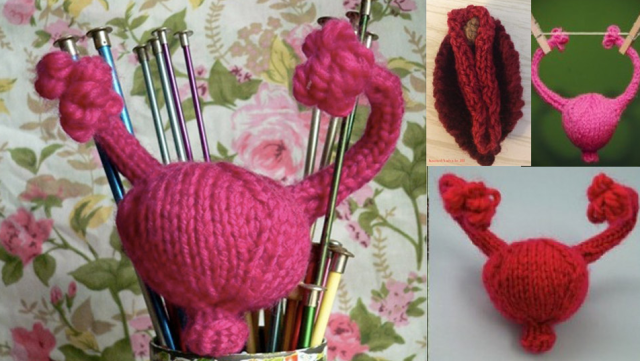
Government Free VJJ, DIY Uteri and vaginas. Share with your legislators.
The women behind Government Free VJJ have a different approach than we do, but its equally effective. They say:
“Whether you are a Democrat, a Republican, or an Independent, female or male, please join us in sending a strong message to our government representatives.
“Follow these simple steps,” their website beckons…
1. Knit or crochet a vagina or uterus. http://www.governmentfreevjj.com/the-patterns/
2. Print a message to enclose.
3. Mail it to your male Senator or Congressional Representative [links provided]
4. We’re in the process of arranging hand delivery to congressional offices in Washington, until then, go ahead and mail yours in!
5. Record your items in this spreadsheet so we can track which representatives still need to receive a “gift”!
6. Don’t forget to thank your representative if he respects women and supports our rights.”
You can join them on Facebook too.
There are other artists who have adopted the uterus as a subject and symbol, and not all of it is focused exclusively on reproductive choice. Some, like The Uterus Flag Project are social practice art projects to increase the awareness of over medicalization of women.

The Uterus Flag Project, a social practice art project to increase the awareness of over medicalization of women.
Escondido artist Terrilynn Quick is asking participants to be a part of The Uterus Flag Project. She discovered this need while doing her MFA- Feminism,Fiber Arts and Craftivism and for her final grad show coming up in July 2012. She is seeking contributions. Her personal political concerns are about the over medicalization of women, and specifically having an unnecessary hysterectomy. On her blog she asks if you have a story, and to please share it and participate. You can contact her and she will send you a packet. Here is the Project Facebook page.
Uterus Flags have been touring in Europe for a while too. Billed as ‘public intervention’ they make the lack of awareness of women’s concerns more visible.
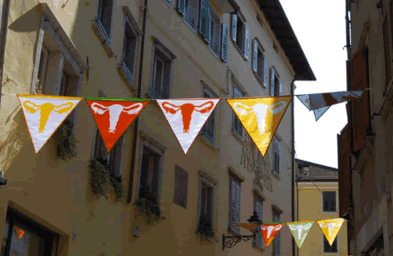
Artists Libia Castro and Ólafur Ólafsson install Uterus Flags in Rovereto, Italy
Artists Libia Castro and Ólafur Ólafsson ( who have established their center of work in the cities of Rotterdam and Berlin.) have exhibited Uterus Flags in various European cities. The flags are essentially a bunting in 9 different color combinations, inspired by heraldry and party-flags, but they bear the silhouette of the female sexual organs; uterus, falopian tubes, ovaries and vagina.
Another interesting creative project is Incorporate My Uterus, a project of the Florida ACLU. They say:
Coast to coast, conservatives get elected by promising smaller government and less business regulation but as soon as they get elected, they rush to put big government regulations on the personal freedom and privacy of your body. It’s a clear double standard. To them, there are too many regulations on pharmacies and fruit stands but not nearly enough government rules about your uterus.
It was inspired by the following quote by – Representative Scott Randolph of Florida.
“The point is that Republicans are always talking about deregulation and big government. But I say their philosophy is small government for the big guy and big government for the little guy. And so, if my wife’s uterus was incorporated or my friend’s bedroom was incorporated, maybe the Republicans would be talking about deregulating.”
The more I have looked the more I have found systematic outrage across the country at the efforts to regulate women’s reproductive lives by imposing particular moral and religious perspectives. Organizations like the Women’s Media Center are working to make sure women’s perspectives are better represent in the media, and that sexism is called out when it occurs. Many individuals, including artists, are fighting back in our own ways.
We invite you to join our project or create your own. I know there are many more feminist creative projects out there focusing on reproductive justice and rights. Please send us links to those projects in the comments, whether they are uterus-centered or not.

Join us for Art Workshops at the Frank Lloyd Wright designed Wyoming Valley School Cultural Center outside of Spring Green, Wisconsin
I am deep in planning a series of summer workshops at the Frank Lloyd Wright designed Wyoming Valley School Cultural Center near Spring Green, Wisconsin for summer 2012. Below are the workshops that I, Liese Pfeifer, Subanna Nur (Bev Gordon), Marian Farrior and Jo Dusick will be offering at the Wyoming Valley School Cultural Center.
Located between Spring Green and Dodgeville, Wisconsin it is near such wonderful cultural opportunities as the American Players Theater, Frank Lloyd Wright Hillside Studio and Theater, and the The House on the Rock.
The school is itself a wonderful place to create and learn. I was delighted to be able to offer two workshops there last year during the first summer open to the public, and can’t wait to be back this summer. Thanks to the work of the Cultural Centers volunteer Board we now have access to an architectural gem by one of our for most American Architect who made his home and school nearby.
The Wyoming Valley School is an art piece in an of itself. Built in 1957, the school was designed by Frank Lloyd Wright, who donated his design (and 2 acres of land) to the Wyoming School District in honor of his mother, Anna Lloyd-Jones Wright. She had been a kindergarten teacher and taught him his lifelong love of learning. The school opened in 1958 with 46 students in grades 1 through 8.
This was my grade school for first through sixth grade. I was one of the local children who started the first grade there in 1959. (Our family farm was about a mile away). There were two classrooms and a gym/cafeteria. There were also three grades in each school room with 4-8 students in a class. Each room full of student were taught by one teacher who would work on lessons with one class while the rest of us did our homework and studies our lessons.
When attending a two classroom school, if you were precocious or slow in a subject you could join in the lessons of the class that was working at your level. We has a floor to ceiling cupboard that was our library and I received an award for reading all the books in the library. An art teacher (Mrs. Polly Hocking) came to teach us once a week. In that school I learned to love learning and I learned to love art.
The River Valley School district used the building until the school closed for good in 1990. In August of 2010 the school was given to the not-for-profit Wyoming Valley School, Inc., by Jeff Jacobsen in recognition of his admiration for Wright. We who are able to use the school again are delighted and thank the volunteers are making it possible for the community to use the school and enjoy Frank Lloyd Wright’s wonderful architecture.
The Wyoming Valley School is currently hosting Wednesday Night Gatherings for artists and writers from Southwestern Wisconsin from 6:30 to 8:30 PM. Join them! . If you would like to donate to support the Wyoming Valley School Cultural Center go here.
So, come and join my friends and I this summer at the Wyoming Valley School Cultural Center for lessons in Art, Nature, and Creativity! Check out fees and register here.

Sunset Hill, 14 x 19 1/2, watercolor, ©2011 Helen Klebesadel
Watercolor: A Fresh Start with Helen Klebesadel, June 29-July 1, 2012 (2.5 days). Schedule: Friday afternoon (4-8), all day Saturday (10-4), and Sunday (10-4).
Watercolor: A Fresh Start is a beginning or refresher workshop, but more experienced artists welcome. This watercolor weekend is designed for absolute beginners as well as for those who have had some experience painting with watercolor but need a refresher to start again. Plan on enjoying this opportunity to learn or re-learn watercolor from an artist passionate about the medium. Workshop participants will explore basic traditional approaches to watercolor painting as well as fresh and experimental watercolor techniques. The goal is to send participants home with the skills and tools to keep on painting. A list of recommended places for lodging and meals will be provided. Plan to bring a sack lunch daily. Workshop limited to 15.
 Give Meaning and Memory through Mixed Media I & II, with Liese Pfeifer. June 29-July 1, 2012 and/or August 17-19, 2012. Both workshops (2.5 days), Schedule: Friday afternoon (4-8), all day Saturday (10-4), and Sunday (10-4).
Take the total Workshop or register for each day separately (below). This course progresses through three parts (separate register possible) for beginner creative soul or experienced artist. Each class has guided exercises. Using play and intuition as a creative source is encouraged and some formal elements are taught
Introducing Liese Pfeifer. Liese believes art enhances our living in this world and the process of creating nurtures our self. As a consultant with Integrated Art Group she builds diverse art collections for corporate and healthcare clients. She is Curator of the Design Gallery in the School of Human Ecology at UW where she is working towards a grand reopening this fall. Pfeifer’s art, like her teaching, encourages a spiritual connection through self acceptance in art play. She maintains an environmentalist ethic in her living.Whole Workshop (See daily descriptions below)
Workshop 1A: Perception and Intention in Art with Liese Pfeifer. June 29, 2012, Friday Only 4:00-8:00 PM. Explore the difference between how our work is perceived and what we intended. What choices do we have in execution that will help our intention. Brush up on design basics that inform your ability to create impelling compositions. This eye opening workshop will be both lecture and experiential. Materials provided or bring your favorite sketchbook.
Workshop 1B: Found Object Dilemma/Breaking the Rut with Liese Pfeifer. June 30, 2012, Saturday Only, 10:00-4:00. How to bring chaos into harmony; Use a variety of recycled materials to create something new. Technical workshop about connecting objects using adhesives, binding, joining and fastening. Emphasis will be on playing as a means to creation. Bring your collection of found objects, some will be provided. Bring sack lunch.
Workshop 1C: Mixed media collage as purveyors of meaning, with Liese Pfeifer. July 1, 2012, Sunday only: 10am-4pm. Create a mixed media sculpture or work with collage elements on a board using a personal collectable as focal point. Discover what arises from combining seemingly random images. Bring found objects, favorite pictures, or favorite fabric. Supporting materials provided.
 Introduction to SoulCollage®: Intuition Through Imagery with Subanna Nur (Beverly Gordon). July 15 2012, Sunday 10:00-4:00. SoulCollage® is an exciting and powerful process of working with visual images (cutting and pasting from printed photos–no particular skill, artistic ability or experience needed) and then using the cards to access information from your own inner guidance—your intuition and personal imagery. (You make cards that function as a personal “deck” that can be used like tarot cards or other tools for individual exploration.) The card-making is satisfying and fun–and a discovery in itself—but it’s only the first part; then you learn to do “readings,” to learn what the cards you have made have to tell you. This seemingly almost magical process brings forth an even deeper level of wisdom.At this workshop you will experience both card-making and the interpretation/reading process. You will learn how SoulCollage® cards can be used and ways you can go further on your own. All materials will be provided. Bring a sack lunch. Workshop limited to 10.
Introducing Subanna Nur (Beverly Gordon): Subanna is an artist, writer, and recently retired Design Studies (UW-Madison)professor who has been working with visual images, found and natural objects, spiritual practice and personal growth for nearly 40 years. (SoulCollage® brings all of this together
 Patterns In Nature Workshop with Marian Farrior and Amy Jo Dusick. Monday, July 16, 2012, 10:00 am to 3:00 pm. Learn about the fascinating world of patterns in nature. Topics include the interplay of form and function, the math and geometry of specific patterns, the science and art of the pattern, how these patterns can be applied in garden designs, and how these patterns might influence our lives. We will practice our observation skills outdoors, do some reflective practices, and use patterns to design creative projects. Dress for indoor and outdoor activities. Bring your own lunch and beverage, and pen and paper or journal for taking notes.

Last White Poppy, watercolor, 9×12, ©2011 Helen Klebesadel
Watercolor From the Center with Helen Klebesadel, July 16-20, 2012 (5 days of workshop), Schedule: 10:00-4:00 daily. Watercolor From the Center is a week-long watercolor workshop to encourage individuals to find or expand their own authentic artist’s voice and subject matter. Designed or advanced beginners through professional artists. Through a series of guided exercises using mixed media and watercolor participants will take the first steps toward developing a personal iconography in their art making and toward overcoming the internal censors that stop us from moving forward. This workshop will take a number of creative approaches to learning how to use your own life as a resource in your art. In general the mornings will be used for guided exercises and the afternoons will be open painting sessions with the instructor offering feedback as needed. The workshop is designed to accommodate experienced and beginning artists who would like to participate in guided projects that will open you up to new directions. A list of recommended places for lodging and meals will be provided. Workshop limited to 15

Ocotilla, watercolor, ©2011 Helen Helen R Klebesadel
Watercolor: The Expressive Medium with Helen Klebesadel, August 17-19, 2012 (2.5 days). Schedule: Friday afternoon (4-8), all day Saturday (10-4), and Sunday (10-4). Watercolor: The Expressive Medium is a weekend workshop designed for advanced beginners through experienced painters. Drawing skills are useful but not required, and you do not need previous experience using watercolor to participate. Participants will explore a wide range of traditional and experimental techniques in transparent and opaque watercolors while they explore the possibilities of this expressive painting medium. Whether you enjoy painting from nature or you are ready to explore your own imagination, this course will give you the tools and direction you need to create strong statements in watercolor. Participants from previous workshops are welcome to repeat this class. A list of recommended places for lodging and meals will be provided. Workshop limited to 15
Plan to join us at the Wyoming Valley School Cultural Center this summer! Contact me with any questions.

Madison artist Mary Kay Neumann in her garden of watercolors
UPDATE: There will be an Exhibition Closing OPEN HOUSE for this wonderful exhibition on Sunday, April 29, 2012, 1 o’clock -3 o’clock pm. Plan to come if you are going to be in Madison.
One of my favorite Wisconsin artists, Mary Kay Neumann was kind enough to give me a preview of some of her newest paintings.
I have loved the intense and spontaneous feel of Mary Kay’s deeply moving watercolors since I first saw them. Her wet-into-wet watercolor florals are alive with emotions of joy, conflict, and and the intrinsic beauty of life. I’m delighted to get to show you some of her most recent works.

Falling Slowly (for Scout), watercolor, 30x22, ©2012 Mary Kay Neumann
Her newest exhibition, Art Still Has Truth, Take Refuge There, runs March 19 through April 30, with viewings by appointment (email marykay@mknart.com). An artist’s reception, open to the public, is March 24, 5–9 p.m., at PilateSpa Studio, 2045 Atwood Ave., Suite 107. For more information, visit mknart.com. (Update: The exhibition is lovely. It is well worth the effort to call an make an appointment for viewing. Mary Kay’s paintings are alive with color and texture. Enjoy!).
Mary Kay’s says of her own work: “Artmaking can be an avenue of social change. This past year, Wisconsin has been overwhelmed by explosive politics. Many families, neighbors, friends and coworkers have become estranged from each other during this tumultuous time. My intent is to bring people together, leave their differences aside, and seek refuge in art”, says Mary Kay Neumann.
HOWL, watercolor, 30x22, ©2012 Mary Kay Neumann
Mary Kay lives her beliefs every day. In addition to being an artist she is a trauma therapist who started a psychotherapy clinic for feminist therapy in Madison in 1988. She advocates for positive social change on the personal and societal level in one way or another in every part of her life as both artist and therapist.
“I work with many people who have been abused and see dignity and bravery in their efforts to overcome trauma. While painting or doing psychotherapy I move back and forth between what is painful and what is joyous. The faces of my intensely colored flowers sometimes reflect a struggle to exist. I deliberately infuse emotion in my flowers and invite the viewer to see the beauty in imperfection. Making art and doing psychotherapy both involve the search for what is honest and true…to make meaning out of chaos. ‘Art still has truth, take refuge there’ is a line from a poem by Matthew Arnold. I experience that phrase as a clarion call.”

Riders on the Storm, watercolor, 30x22, ©2012 Mary Kay Neumann
“As a feminist, the personal IS political”
Mary Kay donates 10% of all her art sales to non-profits. She will be donating a percentage of her sales from this exhibition to “Options for Community Living”, a local group that provides residential services to adults with developmental disabilities.
Mary Kay Neumann has shown her paintings in solo and group exhibition in galleries and art centers across the US, including New York City, Chicago, and California. In Wisconsin she chosen traditional and non-traditional venues to bring her art to a broad audience, including shows in Lt. Governor Barbara Lawton’s Office at the State Capitol, the Wisconsin Arts Board gallery, the Pyle Center at the University of Wisconsin, and the 25th Annual Artful Women Show at the UW Hospital and Clinics.

The Heart Aroused, watercolor, ©2012 Mary Kay Neumann
Mary Kay has a strong following of private collectors throughout the U.S.A as well as having works in corporate collections that include Meriter Hospital, Petkovsek & Moran and Red Sage Health in Madison; Dean Clinic in Janesville and D&K Pattern in St. Charles, Michigan. She also was juried into the Percent for Art Program in 2010 , and the State of Wisconsin purchased one of her paintings for their Public Art Collection (Unfortunately that program and several others serving individual artists is now defunct due to cuts to the Wisconsin Arts Board budget)
The exhibition space for the exhibition is the PILATESPA Studio, that Mary Kay calls an “art gallery for bodies”. The Studio is a gem in the midst of Atwood Avenue. The owner, Kathleen Conklin, has been an active arts supporter and promoter for many artists over the years. She has created a lovely art and movement venue that is well loved. Her beautiful space will be a fine setting for Mary Kay Neumann’s colorful paintings of flowers.
To see more of Mary Kay’s wonderful watercolors, plan to come to the opening reception on March 24th, 5-9 and I’ll see you there (tell me if you read this blog).

What A Little Moon, watercolor, ©2012 Mary Kay Neumann
For more about Mary Kay Neumann’s watercolors check out the recent article written about her by Katie Vaughn in a Madison Magazine article: Flower Power
Again Art Still Has Truth, Take Refuge There, runs March 19 through April 30, with viewings by appointment (email marykay@mknart.com). An artist’s reception, open to the public, is March 24, 5–9 p.m., at PilateSpa Studio, 2045 Atwood Ave., Suite 107. For more information, visit mknart.com.

Where Are The Bees? IV, watercolor, 30×22, ©2012 Helen Klebesadel on display at the Benedicta Arts Center in St. Joseph, MN, February 25-April 4, 2012
My newest art exhibition of watercolors is called Aviary, Apiary. It will focus on environmental concerns through poetic and sometimes symbolic representations of birds and bees. It will be on exhibition at the Benedicta Arts Center in the College of St Benedict in St Joseph, Minnesota from February 15th to April 4th 2012, with a reception near the end of its run on March 30th. Twin Cities artist Christine Baeumler will also be showing a multi-media installation on the same theme that reflects upon the vitality and fragility of bird and insect life.
All artists who have spend months developing a body of artwork for exhibition, or prepared to perform in a play or concert, know that the creating the art is only half the work. The other half is finding a way to let your audience where and when and how they can access the aesthetic experience you hope to offer them.
I was talking to an artist friend, Mary Kay Neumann recently about how we might spread the word about an exhibition she has coming up next month (“Art Still Has Truth, Take Refuge There”, opening March 24, 2012, PilateSpa Studio, Madison, WI). We talked about how she was updating her e-mail and snail-mail contact lists, and about the press release she has planned to send to her press list. We also talked about using on-line social networking media to spread the word.
Over the last few years I have been building my on-line presence as an artist a bit at a time both to grow my art community and to make my creative work more visible. Since the topic is relevant, I promised Mary Kay I would use this blog entry to review some of the steps I have taken to use social media to raise the visibility of my art and make it more accessible to a wider audience.

Pollinators I, watercolor, 8x5, ©2012 Helen Klebesadel
Creating an Social Media Network From A Hub
There are lots of different ways for an artist to approach developing an on-line presence and build a social media network to bring visibility to their art. Developing a social media network is really developing an electronic way to stay in touch with people you know, and to meet and build relationships with others who share your interests. The key word here is ‘relationship.’ That implies a two-way street. You share what you are doing, what you are interested in, what may be useful for other to know about as well as respond to what others offer you. If all you do is post about yourself you won’t be maintaining good relationships.
Its taken me a while to learn that in building an online presence you don’t have to be overwhelmed by all the on-line media available to you, nor do you need to use it all. It makes sense to only establish accounts in on-line media you can maintain with regular updates. The best approach is to choose one of the many tools available to you as the hub of your on-line presence and then build from there. A website or a blog can be the hub of your on-line presence, whichever one is a better fit for you. It can then be linked to other vehicles like Facebook, Linkedin and Twitter.
Websites
It is a whole new world in terms of websites, and if you are not someone who can build your own (me either) there are plenty of places willing to design one for you or sites that allow you to customize templates to create your own.
My first web presence was on the free Portal Wisconsin On-line Gallery . The visibility the Portal Wisconsin Gallery gave me several opportunities, including having my art requested for use for a book cover to being asked to allow the use of my art on CDs given as pledge premiums for one of my favorite Wisconsin Public Radio shows, To the Best of Our Knowledge.
Happily this opportunity still exists for Wisconsin artists who apply despite recent budget cuts to the member organizations of the Cultural Coalition of Wisconsin. Its sponsoring organizations include: Wisconsin Academy of Sciences, Arts and Letters | Wisconsin Arts Board | Wisconsin Historical Society| Wisconsin Humanities Council | Wisconsin Library Association | Wisconsin Public Radio | Wisconsin Public Television | University of Wisconsin-Extension–Continuing Education, Outreach & E-Learning
I maintain my presence in the Portal Wisconsin Gallery even though I now have my own artist website. (I am in the process of transforming my current website to make it easier for me to update myself. I’ll show it off once its revised.)
Teaching Art Online
In addition to my artist website I have used the very flexible website platform Weebly.com to build a website for my teaching, called Creativity Lessons. Weebly offers free websites and blog with easy to use templates for FREE. If you want to be able to sell products or services on your site you will have to pay a reasonable annual fee. That is what I did.

Thorn Birds, watercolor, 30 x 22, ©2012 Helen Klebesadel
Art Sales Sites:
I have several places my paintings, prints and related items are available for sale on-line. I self-maintained two on-line stores. These kinda of venue are useful for artists willing to work hard to drive traffic to their stores themselves. For minimal fees they are very easy to use in terms of uploading art and maintaining a sales site that is easy for a buyer to use.
There are other on-line sales venues, several with huge user communities and thousands of buyers using the platforms daily. None-the-less it is still up to you to drive an audience to your store. Most individuals who find your store will have been directed to it from another place: a blog, Facebook, etc.
Print on Demand Fabric Designs
For the past three years I have spent a fair amount of time turning some of my paintings and watercolor experiments into fabrics designs. I have well over 100 designs that can be found on my page at Spoonflower.com. This has been a grand adventure. The Spoonflower Community is full of interesting and creative people exploring the possibility of this new media that extends the possibility of fiber arts in so many ways. If you are interested in designing your own fabrics I have a free tutorial in my Meylah shop that will show you how you can turn your artworks into fabric designs.

Prairie Plenty Fabric Design, available at http://www.spoonflower.com/fabric/115279
Social Networking sites:
I have a Facebook Fan Page, which allows me to announce my art events to those who have chosen to sign up to receive the announcements. Unlike a regular Facebook Page your followers don’t have to become ‘friends’ and share all their personal information to follow you on a Fan Page.
I am also a LinkedIn participant. This is a professional business-oriented platform that has you make ‘connections’ rather than ‘friends,’ There are may useful affinity groups you can join that share useful resources. LinkedIn, like the other social media platforms, have helped me stay i touch with friends and acquaintances and meet others who share my interests and passions.

Pollinators II, watercolor, ©2012 Helen Klebesadel
I also have my blog, Facebook, Linked in and my sales sites all automatically attached to a Twitter Account that let me share my postings to my followers with one post.
Other Fun Sites
The Arts Map is an interactive website connecting artists, the arts, and the community. You can us it to find artist’s studios, arts organizations, arts events, galleries, museums, & more. I put myself on the map here.
I have just started to use Youtube to post a couple of watercolor demos. I hope to work with a friend to develop more virtual lessons and share them.
Exhibbit is a wonderful virtual exhibition platform that allows artists to create and change online gallery exhibitions whenever we want. You can see a video overview of my exhibition here or you can go directly to the Exhibbit site and see what its like to move through a virtual exhibition at your own pace. You will have to download the media program to move through my Flora and Fauna exhibition at your own pace.
The Brooklyn Museum’s Feminist Art Base, is the first online digital archive dedicated solely to feminist art. A project of the museum’s Elizabeth A. Sackler Center for Feminist Art, with the mission to ‘present feminism in an approachable and relevant manner, to educate new generations about the meaning of feminist art, and to raise awareness of feminism’s cultural contributions.’
The Behance Network is a n online platform to showcase and discover creative work. They allow creative professionals to create multi-media portfolios that showcase their work within the Network, as well as dozens of other partner sites and industry-specific, curated online galleries. (I have my portfolio embedded in my LinkedIn profile.)
None of these approaches are necessary to being an artist. Being in the studio and making the art that matters to you is the first and most important thing to do. But when it comes time to share your art and advertise your exhibitions, nothing compares to a good mailing list (and email list) and a solid social networking strategy.

Pollinators III, watercolor, 9x8, ©2012 Helen Klebesadel
I didn’t build my on-line presence all at once. I’ve grown it slowly but surely, one step at a time, as I have had time and attention to take the next step. I do spend a little time on these projects almost everyday, but I have to make sure I maintain a balance between keeping my virtual presence up to date while limiting my time on-line to ensure it doesn’t intrude into my studio time.
So I say, make good art and share it widely. I’d love to hear about what has worked best for you and about any new opportunities in the ever-growing world of social media.
 Desert Rose, watercolor, 9 x 12, ©2011 Helen Klebesadel
In mid December I had the privilege and opportunity to join my friend and sister artist Nikki Kinne for a week of RV camping and plein air painting in southern Arizona. If you have read this blog before you know that Nikki is the Alaskan artist that I did the 33 Paintings in 33 Days Project with this summer, documenting it in this blog. Later, in September Nikki joined me in Door County to help me teach a watercolor workshop at Lawrence University’s northern campus, Bjorklunden. Despite all our fun together in 2011 we still wanted a chance to actually take the time to paint together, and circumstances arranged themselves (with our help) to make that possible.
In mid December I flew to Arizona where Nikki met me at the Phoenix airport and swept me away to the beautiful Desert Rose Baha’i Institute campus where Nikki and her husband Ken park their RV camper. There we experienced a lovely desert sunset, and an evening of catching up. The next morning we set off to drive the RV to Patagonia Lake State Park south of Tucson, near Nogales, Arizona, just north of the border with Mexico.
 Patagonia Lake State Park turns out to be on the migratory path for many birds. It was teeming with all manner of waterfowl. (In fact the 2011 birdwatching film The Big Year did some of its filming there.) Within 15 minutes of being in the park I startled a Blue Heron and several other birds.
Upon arriving in the park I started right in on a plein air, “in the open air,” painting. Plein air painting is important for more than the lovely paintings that can be the result. The joy of taking the time to carefully observe nature is my favorite part of painting this way. There are few times when most of us slow down enough to allow ourselves the privilege of just sitting and looking at the wonder of the nature that surrounds us. There is something about trying to render what I see in paint or pencil that brings a special kind of focused attention to the details of nature. I never see so clearly as when I try to draw or paint what I am looking at. I can sit and stare for hours, seeing with amazement what other times I might not notice at all. If I had never drawn or painted I would start now just so I could give myself permission to learn to look at nature with my full attention.

Padagonia Lake State Park, Arizona, watercolor, 5x8, ©2011 Helen Klebesadel
As night fell over the park more of the magic of the place emerged. As we took an evening stroll the full moon rose over the park with an amazing ring around it. Slowly, as a few clouds moved through the sky the ring around the moon suddenly became a spiral around the moon, evoking an unnatural magic in the natural world. It promised that the whole trip would have a special kind of magic to it, and I was not disappointed.

Spiral Moon, watercolor, 5x8, ©2011 Helen Klebesadel

December 10, 2011 Eclipse, ©2011 Nikki Kinne
It was actually the was the second day of our painting excursion that was the most magical. We were lucky to be in the park on December 10th, 2011. We woke up at 5:00 am and got ourselves down to the lake shore to watch the early morning lunar eclipse. We were determined to be there to watch the moon as it found itself positioned in its orbit to pass through Earth’s shadow. After watching the eclipse we headed back to the camper for breakfast and to capture our memories in sketches.

Lake Patagonia Lunar Eclipse, watercolor pencils, 5x8, ©2011 Helen Klebesadel
Nikki and I each have several other art projects underway and are involved in our home art communities. We spent the afternoon painting and catching up on our current projects, and began to plan for future shared creative projects. 
The creative work of the day wasn’t over as evening fell. We decided to participate in a sunset/moonrise hike in newly formed Sonotia Creek State Natural Area that abuts the park. The hike is offered by park volunteers monthly. With a dozen other people we hiked up a rock and cactus covered hill to the to where we could see wonderful vistas in each direction, Nikki documented the experience in photographs. After a magical evening watching the sun set over Arizona and the moon rise over Mexico we hiked back down the hillside with our memories and Nikki’s photos to inspire visual memory paintings when it was too cold or wet to paint outside. We created these next few paintings to remember the wonderful experience of the transition between day and night in this wild area.

Ocotillo, watercolor, 5x8, ©2011 Helen Klebesadel
A new body of work I have begun includes images of thorny vines. On our hike I became fascinated by the thorny Ocotilla shrubs that cover the hillsides. They seemed to be living embodiments of the metaphor I have been working with as I imagine a new series of paintings. I’ve been researching the plants ever since I came home (their blooms are pollinated by humming birds in the spring and they can perform photosynthesis in their BARK!).

Spiral Cactus, watercolor on canvas, 12x14, ©2011 Helen Klebesadel
For this mid-westerner the Barrel Cactus are fascinating too, especially observing the way their fruit grow, which in this instance seemed to repeat the spiral theme that was with me my whole time in the park. Nikki convinced me to try out painting on a watercolor canvas too. I’ll be exploring this approach more in the future because it was a lot of fun working on a non-absorbent surface that makes lift-out so easy. (You have to seal paintings watercolor canvas with a spray fixative in the same way you seal paintings on Yupo Paper).

Sunset Moonlight Hike, watercolor, 3x9, ©2011 Nikki Kinne
Nikki painted the beautiful work above recording the wonderful vistas we could see from the top of the hill as we watched the sun set. I was inspired by one of Nikki’s documenting photographs to paint the work below.

Sunset Red Lace, watercolor, 12x16, ©2011 Helen Klebesadel
It was a magical day starting with a lunar eclipse and ending with watching the full moon rise over Mexico. I’m sure bits and pieces of the day will appear in my paintings for years to come.

Moonrise over Mexico, watercolor 5x8, ©2011 Helen Klebesadel
During our five days in the park we painted from life when the weather allowed and captured our experiences of the area as memories when it was too cool or rainy to paint outside. We also spent a day being tourists, heading to Tubac, a local artist community (the town has been hosting the Tucbac Festival of the Arts every February since 1959.) I’d love to return their in February to catch the festival and revisit some of the artisan shops we saw.

Patgonia Lake in the Rain, watercolor, 12x16, ©2011 Helen Klebesadel
The last couple of days in the park were amazing rainy days, putting a hold on our plans to do further plein air painting. I was able to do some nice little grey paintings out the window of the camper (above) but we were not to get another chance to actually paint outside. We both worked on our memory pieces and developed ideas for future works. Nikki finished the painting sevre in-progress pieces and the painting below in anticipation of an upcoming show.

Wild Rose, Watercolor on Aquaboard, 10x14, ©2011 Nikki Kinne
It didn’t feel limiting despite our inability to go outside. (Who knew it would rain so much and for so long in December in Arizona!) We were able to work from our memories, sketches, and documentary photographs. I found that by thinking of the little paintings I was doing as saving visual memories and ideas for future works rather than fully finished artworks I was free to play and just see what happened.

Kinne Klebesadel Camper Exhibition, Patagonia Lake, December 13, 2011
Because of the rain we spent a pleasant two days painting indoors, catching up, and planning for our next joint project. We are just starting another collaborative project. We have begun to work on new bodies of artwork that will address a shared theme focused on growth and renewal out of dark times. We hope to be ready to exhibit the work in 2013, and are looking for venues that would be interested in exhibiting watercolors so please send suggestions of possible places to exhibit this new work together.
 On our last day we headed north to Scottsdale where we were treated to a personal tour of the Scottsdale Museum of Contemporary Art by the my friend Timothy Rodgers who is its Director. Its a lovely museum doing very exciting programing with changing exhibitions, as well as being the home of an amazing James Turell skyspace called Knight Rise.

Nikki Kinne in the driver's seat. Thank you Nikki!
From the museum we headed back to the airport, where I bid goodbye to Nikki and my wonderful week of painting plein air and creating visual memories. Thanks to Nikki Kinne (and Ken Kojker) for sharing their camper and giving me a very special time in painting in Arizona.

Helen Painting, digital photo, ©2011 Nikki Kinne
If you have never taken the time to sit and stare at where a ridge meets the sky or how a branch attaches to the trunk of a tree, or how a hillside reflects in a lake, I encourage you to put all fear aside and go for it. If you do you could discover that the experience of careful observation is satisfying in itself and that it is aided by trying to record it as a visual memory. If you do want to consider plein air painting or drawing here are a few hints about how to set yourself up for a successful experience:
Here is what I pack for plein air painting expeditions:
7×9 Arches Field Watercolor Book
9 x 12″ and 12 x 16″ Arches watercolor blocks (Watercolor blocks are great because the paper doesn’t have to be stretched and you do not need a board to attach you paper to, but since the watercolor paper is layered and glued in a solid block you cannot remove your painting from the block until its dry. You will need two, so you can work on a second painting while the first painting is drying.
Canteen of water to drink and to paint with
At least three of my favorite brushes, #8, #4, #2 rounds
Set of 12 watercolor pencils and/or permanent colored ultrafine sharpies
Rubber shaper brush to apply mask
Rubber Cement Pickup to remove mask
Old toothbrush for texture painting and applying mask (I spatter the mask with a toothbrush to achieve the stars in night skies).
A roll of masking tape ( I like to mask off the borders of the paintings I do for the visual effect but this is not necessary on a watercolor block).
Two small water containers, one to clean the brush and one to provide clan water to paint with.
Two packets of paper tissue or a small roll of paper towels
#2 Pencil and sharpener
I have two favorite watercolor kits that I use depending on the occasion:
Small: Winsor Newton Field Set (this and a set of watercolor postcards are all you really need)
Larger: Capri Watercolor Box (this allows me to carry my studio on a shoulder strap. I can use my tube watercolors in the included pallet, and have room for my brushes, extra paint and a water container).
Bring a small camera to document what you are painting to review later if needed.
Decide if you need to bring something to sit. Dress comfortably, wear a cap or wide brimmed hat to keep the sun out of your eyes. Prepare for bugs.
Have a great time!
Finally, one last thank you to Ken Kokjer for giving up his time with Nikki and to Nikki Kinne for sharing her precious painting time in Arizona with me. What a gift! I had great time!
 This is a Little Free Library that I was delighted to have the opportunity to cover with paintings of some of my favorite images of Wisconsin flora and fungi. My library, entitled It Is Always the Season To Read, will join those of nine other artists whose work painting Little Free Libraries will be on exhibit at Story Pottery in Mineral Point in December.
The exhibit opening is 7-9pm, Saturday, Dec. 3; Gallery Night in Mineral Point. Story Pottery is at the corner of Commerce and Fountain Streets. Music from the Krause family and the works of many other local artists will be presented. Little Libraries made from recycled Eatmore Cranberry crates will also be on display, as will a Library decorated entirely in birch bark totems from the Mille Lacs reservation and the products of Amish craftsmen.
Proceeds from my Library sale will go to the Grassroots Leadership College (GLC). I serve on the board of the GLC. It is a wonderful Wisconsin organization offering trainings and activities that support community engagement related to their mission “Everyone is a Learner, Everyone is a Teacher, Everyone if a Leader.” It offers an organizing semester for aspiring leaders, community forums and other workshops, including the ‘Prepared and Peaceful’ non-violence trainings that were so effective at the Madison Capitol during the protest gatherings last spring. (You can donate to continuing the work of Grassroots Leadership College, or become a sustaining member, on their website here: http://www.grassrootsleadershipcollege.org/)

The very first Little Library was built in the memory of June A. Bol. It sits in the front yard of a home above the St. Croix River in Hudson, Wisconsin.
I have been following the little free library movement since first discovering one of the libraries while walking my dog in my near East-side Madison, WI neighborhood. I learned that the little free libraries are an entrepreneurial approach to promoting literacy and the love of reading by building free book exchanges worldwide, as well as working to build a sense of community through share skills, creativity, and wisdom across generations.
There is a network of Little Libraries where I live in Madison, Wisconsin and the surrounding area now includes more than 40, hosted by families, neighborhood groups, coffee shops, businesses and schools.
Little Free Library Stewards (sponsors) may provide the books that stock the libraries, often with themes specific to their location or to the concerns of their sponsoring organizations. The Little Free Library coordinators also have relationships with organizations, publishers, and other sources of books that can help establish a themed collection. Operating under the principle that ‘you cannot steal a free book’ the organizers have found that there are very few negative incidents.
The organizers hope to endow more than 2,500 libraries around the world, with the goal of topping their inspiration, Andrew Carnegie who funded 2,509 full-sized free community libraries between 1888 and 1929. Each of these Little Free Libraries will offer books free to the general public. Their collections change as more people give and borrow books.

I was inspired to paint a one-of-a-kind Little Free Library (LFL) after meeting Richard Brooks at a yard sale fundraiser I was coordinating to support the ongoing work of the Grassroots Leadership College (GLC). (Rick Brooks is a co-founder of the project along with Todd Bol ). Rick dropped off donations for a yard sale and chatted with me just long enough to convince me I wanted to contribute my creativity to support both the Little Free Library movement and the Grassroots Leadership College. Rick left the yard sale with one less library in his vehicle and I had added a new project to my plate.

Yellow Lady Slippers, watercolor, 24x22, ©2011 Helen Klebesadel
I decided that in painting my first little free library I would paint the fours seasons with environmental and nature themes I have explored in my watercolors. I love painting the wild orchids of Wisconsin, and the spring plenty of the wild morel mushrooms. I’ve included many of my favorite watercolor subjects in nature from each season. The spring lady slippers, trillium, and morel mushrooms, give way to summer sunflowers, lilies, cone flowers and iris as you move around the library.
 By the time I move into fall and winter I painted asters, sumac, daisies, more cone flowers, with a background of bare winter branches. Most of these subjects have occurred in my paintings before, including one of my favorite topics of the lace of winter branches.

Winter Lace, watercolor, 30x22, ©2010 Helen Klebesadel
The non-profit Little Libraries project promotes reading for children, literacy for adults and libraries around the world. As they the project participants build Libraries for their neighbors, they also raise funds to build similar book exchanges in other communities in need, especially in developing countries. They do that through their Wisconsin Partners “Pay it Forward Fund,’ with contributions from the Madison Community Foundation and Capital Times Kids Fund and individual donations, have made it possible for many communities to participate.
Individuals and organizations can purchase a library or you can get the plans to build your own and register for a small fee donated to the ‘Pay it Forward Fund.’
Soon, as volunteer labor allows, each Little Free Library will have their Global Positioning Coordinates marked on a Google Map so they can be visited.
Many communities organize the purchase of a library with fundraising or marketing campaigns around an issue or an organization they want to bring attention to, much like I am using my library to bring more support to the Grassroots Leadership College. Local nonprofits, businesses and institutions have expressed an interest in supporting 5, 10, 20 or more Little Libraries as part of their outreach efforts.
There are a number of ways you can join the Free little Library movement, help provide free, good books for people, and promote a love of reading and literacy. You can volunteer to be a builder, a sponsor, or a steward, or a contributor to the Pay it Forward Fund that ensures every place that wants a Little Free Library can have one.
Oh yes, and you can contribute your creativity to painting, decorating, or creating new styles and creative construction of the one-of-a-kind libraries. Take it from me, its a lot of fun!


I’ve been thinking a lot about how the media is representing the Occupy Wall Street Movement (now worldwide), how new social networking media allows it to control its message, and how it compares with how past activist movements focused on positive social change have been represented. In particular, I thought of the Women’s Action Coalition. It was started in New York City in 1992, in response to the outrage they felt about Supreme Court Justice Clarence Thomas’ confirmation hearings. The logo that has been used to represent the WAC was the blue dot used to obscure a rape victim’s identity during trials. Many of the participating members were women artists. Chapters were subsequently formed in other U.S. cities, including Boston, San Francisco, Houston, and Los Angeles, as well as internationally in Canada and Europe. WAC employed a direct action approach similar to that of the AIDS Coalition to Unleash Power (ACT UP) and the Women’s Health Action Coalition (WHAM), which encouraged activities such as demonstrations, sit-ins, civil disobedience, educational forums, and letter writing campaigns. This organization was considered a grass-roots organization with no hierarchical structure (sound familiar?). WAC maintained a high profile and national actions for at least two years. What might happen if Occupy Wall Street (with its great inclusion of Occupy art) maintains the momentum to continue for two years or more?
I started thinking about what has come before, the lasting effects, and how it has and has not been documented. That got me looking around for a larger discussion of the feminist movement in the U.S. and in particular, the Feminist Art Movement. If you look for it you can find a fair amount of documentation of earlier social justice actions, including those in the arts.
(I’ve corrected an error and added additional information in the paragraphs below since first publishing the blog entry.)
There have been a number of important exhibitions documenting feminist art and activism in recent years. Their catalogs are useful sources of information on the art and artists.
One such source is the catalog for Wack! Art and the Feminist Revolution, which was a 2007 exhibition curated by Connie Butler for MOCA that sought to document feminist art practice from 1965-1980. Its title references the acronyms of a lot of activist groups from the late 1960s and early 1970s that were undertaking cultural work relating to a range of issues, including women’s issues. The groups included Art Workers Coalition (AWC) , Women Artists in Revolution (WAR) , and Women’s International Terrorist Conspiracy from Hell (WITCH) (Humor in protest performance to make a point is not new. In 1968, women from W.I.T.C.H. staged a “hex” of Wall Street at a branch of Chase Manhattan Bank, wearing rags and fright makeup).
Another catalog from the same year, Global Feminisms: New Directions in Feminist Art, curated by Linda Nochlin and Maura Reilly, emphasizes that there is “not a single unitary feminism any more than there is a timeless, universal ‘woman’, but rather, that there are varied, multiple, unstable constructions of female subjects and their predicaments and situations. ”
Other useful overarching survey books include:
The Power of Feminist Art: The American Movement of the 1970’s, History and Impact, edited by Norma Broude and Mary D. Garrad, 1996, and
Arts and Feminism(published first in 2001 but coming out soon in paperback) by Helena Reckitt and, Peggy Phelan.
Continuing my research I found a wonderful interview with Ruth Weisberg, a co-founder of the Women’s Caucus for Art and a past president of the College Art Association. This interview is a part of the fabulous Otis College of Art and Design, Pioneers of the Feminist Art Movement which includes such feminist artists from Los Angeles such as: Rachel Rossenthal; Joyce Kozloff; Bruria Finkel; Gilah Hirsch, and Helen Redman. The Redman interview includes a nice segment with artist Anne Isolde, the historian for Judy Chicago‘s feminist installation The Dinner Party.
These videos emphasised west coast feminist art which was centered around the Los Angeles Women’s Building and the Feminist Studio Workshop (one of the first feminist art schools for women started in 1973 by Judy Chicago, Miriam Schapiro, Sheila Levrant de Bretteville, and Arlene Raven).
I continued my search for available interviews with founding feminist artists who were not based in LA, leading me to Miriam Schapiro and Mary Beth Edelson discussion of the idealism in the Feminist Art Movement. They mention the emergence of west coast feminist art collective Heresies (1977-1992) and their journal, which is remembered in the documentary Heretics. Thanks to the film producers you can download copies of the journal Heresies here. Other members of the Heresies were Joan Braderman (director of Heretics), Mary Beth Edelson, Harmony Hammond, Elizabeth Hess, Arlene Ladden, Lucy Lippard, Miriam Schapiro and May Stevens.
Those that know me personally know its not an accident that my day job is directing the UW System Women’s Studies Consortium. I am a feminist and an artist. My interests are especially engaged where those two identities meet. You may be able to tell that I have great respect for those women artists who worked before of me to make a place for women’s creative voices in our national cultural dialogs. I have fond memories of being a past president of the national Women’s Caucus for Art (from 1994-96), the oldest (40 years of feminist activism) multi-disciplinary women’s art organization in the U.S.
 The Women’s Caucus for Art (WCA) grew out of women’s activism to make the College Art Association (the major scholarly organization for academically based studio artists and art historians) a more user friendly place for women in the 70’s. The WSC currently has 27 local WSC chapters that are joined in a network under the umbrella of the national organization, with a number of caucuses that include the Jewish Women Artists Network (JWAN); the Eco-Arts Caucus; and the International Caucus. They also have an active Young Women’s Caucus (YWC) where emerging women artists are defining their own version of contemporary feminist art.
Ruth Weisberg was one of the artists who has been recognized in past years by the Women’s Caucus for Art with their Lifetime Achievement Awards. The 2012 awards are being jointly presented by the Women’s Caucus for Art and the College Art Association Committee on Women at the annual conference February 23-27 in Los Angeles. The 2012 recipients are historian Whitney Chadwick, artist Suzanne Lacy, art librarian and co-director of the Feminist Art Project, Ferris Olin, feminist gallery owner Bernice Steinbaum, and feminist film-maker and scholar Trinh T. Minh-ha. These awards have been given since 1979, and the recipients are a whose-who of feminist art. The WCA now makes the awards catalogs available in PDF form on their website.
Other documenting video of the US Feminist Art Movement:
Women Art Revolution is a documentary that follows the feminist art movement over four decades. This interview with director Lynn Hershman Leeson gives a little background on the film, including a couple of congressional responses to Judy Chicago’s important feminist installation, the Dinner Party, and an interview with a founding Guerrilla Girl.
KT Press, publisher of n.paradoxa international feminist art journal offers a fine international list of feminist exhibition catalogs, as well as a chronological list of feminist art Manifestos and Feminist Manifestos that have had an impact on the women’s art movement and the creation of feminist art. They also offer an international list of journals and books and articles on contemporary feminist art practice, as well as international feminist art websites.
Here are a few additional US feminist artists among the many, many more you should have heard of and been taught about. (Please forgive me for all those many important feminist artists I have not listed). Check out the Brooklyn Museum’s Feminist Art Base for many other feminist identified artists.
Jerri Allyn; Ida Applebroog; Tomie Arai; Ruth Asawa; Eleanor Antin; Laura Aguilar; Nancy Azara, Judy Baca; Judith K. Brodsky; Beverly Buchanan; Elizabeth Catlett; Leonora Carrington; Tee Corinne; Betsy Damon; Joanna Frueh; Cherie Gaulke; Esther Hernandez; Holly Hughes; Barbara Kruger; Hung Liu; Yolanda López; Margo Machida; . Muriel Magenta; Agnes Martin; Anna Mendieta; Elizabeth Murray; Alice Neel; Catherine Opie; Beverly Pepper; Howardena Pindel; Adrien Piper; Jaune Quick-To-See Smith; Faith Ringgold; Martha Rosler; Betye Saar; Cindy Sherman; Carolee Schneemann; Lorna Simpson; Sylvia Sleigh, Barbara T Smith; Nancy Spero; Mierle Laderman Ukeles; Kay WalkingStick; June Claire Wayne; Faith Wilding; Hanna Wilke; Flo Oy Wong; Yoko Ono


 Helen Klebesadel: A Muse and Her Artist